Darkness and Light Day Six

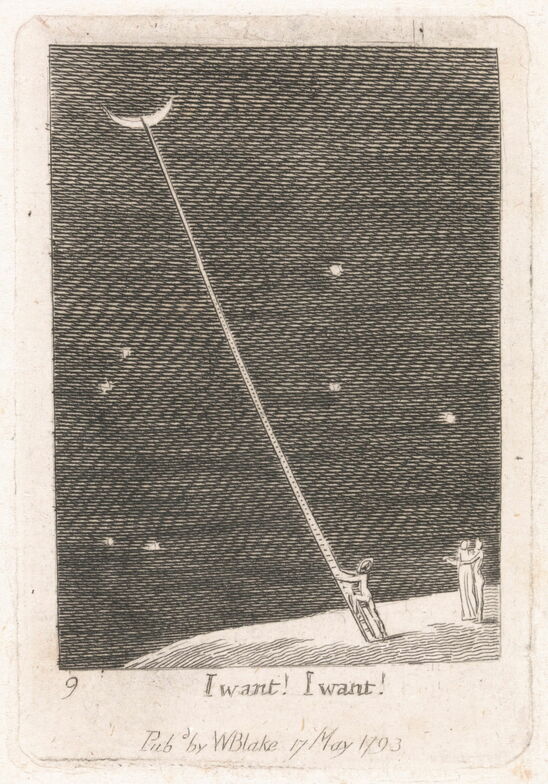
I Want! I Want (aka Even the Moon) from William Blake's 'Gates of Paradise' (Image found here)
From 'Public Doman Worldwide' - an explanation by Hunter Davies
Unlike Blake’s most famous engravings, which interlace text and image, the visual dimension dominates across The Gates of Paradise. Here we can see Blake’s interest in “emblem literature” — sixteenth and seventeenth century books that link an allegorical symbol to an epigram or motto, such as Francis Quarles’ Emblems (1635), George Wither’s A Collection of Emblemes (1635), and Devises et Emblemes Anciennes & Modernes (1699). The reputation of this format has suffered from its bludgeoning moral quality, which one scholar describes as a genre that never escapes mediocrity and doubles down on the banal. But Blake makes a sometimes tiresome tradition strange once again.
While they touch upon Christian themes, The Gates of Paradise are shocking for their scenes of vibrant ecology, human figures mixed and remixed with the earth. In an image coupled with the phrase “I found him beneath a Tree”, a female figure yanks smiling children up from the ground, like unrooting carrots, recalling folklore related to the mandrake: how its screams signal a hellish fate for whomever harvests the root. Paired with the caption “What is Man!”, a caterpillar gazes on a leaf-bound larva with the face of a child, summoning Blake’s proverb in The Marriage of Heaven and Hell: “As the caterpillar chooses the fairest leaves to lay her eggs on, so the priests lays his curse on the fairest joys”. Elsewhere: angels emerge from avian eggs; a pining figure follows his desire up a ladder, away from the world. Even the elements themselves are embodied. “Earth” is a squat man entombed alive and “Air” becomes a body lacking enclosure, a preoccupation across Blake’s The First Book of Urizen (1794).
(emphasis mine)
Full article here.